Monday, December 22, 2014

TEICHELMANN, Ebenezer

 Evening Post, Volume CXXVI, Issue 149, 21 December 1938, Page 14


                                       Noted Mountaineer
Dr. E. Teichelmann
Death At Hokitika 

New Zealand has lost one of her noted mountaineers through the death of Dr. Ebenezer Teichelmann, F.R.C.S., M.R.C.S. (Eng.), L.R.C.P. (Ireland). Associate of Mason's Science College (Birmingham). He died at Hokitika yesterday.

Dr. Teichelmann was surgeon superintendent of the Westland Hospital for about twenty years, but retired eighteen years ago. He was widely known in New Zealand because of his mountaineering work and was in Wellington for the last annual dinner of the New Zealand Alpine Club.


Dr. Teichelmann was born in South Australia in 1859. He was educated at Hahndorf College, at Adelaide University, and at Queen's and Mason's Colleges, Birmingham, England. He also studied at St Bartholomew's Hospital, London, and at hospitals in Dublin. Ireland. For a time he acted as demonstrator of physiology at Mason's College, was assistant physician and resident pathologist at the General Hospital, Birmingham, assistant surgeon at the Jaffray Suburban Hospital, resident medical officer of the Birmingham Workhouse, and later spent two years in private practice in England. Upon returning to Australia he was health' officer at Port Adelaide for two years. He came to New Zealand in 1897 to accept the position of superintendent of the Westland Hospital.

At the outbreak of war in 1914 Dr. Teichelmann, although he had difficulty in obtaining a position with the Forces because of his German ancestry on his father's side, secured a commission in the New Zealand Medical Corps with the rank of captain. He served overseas from 1914 until 1917, and was one of the survivors of the troopship Marquette which was torpedoed in the Aegean Sea.
 
Exploring and Climbing.
Many contributions to mountaineering in New Zealand were made by Dr. Teichelmann. He first became interested in climbing through engaging in prospecting for gold up the Kellery River, but as soon as he v commenced mountaineering he followed what was to be his lifelong hobby with enthusiasm. Although he was a small, spare man, he proved a capable climber and was nominated and elected a member of the Alpine Club (London) in 1903.

He came into prominence through carrying out some noted exploration work in the headwaters of the Wanganui, where he climbed a number of peaks. He also did a good deal of exploring at the head of the Cook River, but the pioneering work had been done there before his time. From the time he was elected to the Alpine Club until he went overseas with the New Zealand Expeditionary Forces he made many ascents, several being first ascents, and a monument to the part he played in New Zealand mountaineering will always remain in Mount Teichelmann (10,370 ft) in the Southern Alps, which was named after him.

Dr. Teichelmann was the first to climb some of the peaks at the head of the Cook River from the westward. and he was the first to cross the Harper Saddle from the west, making the crossing some years after Mr. A. P. Harper, Karori, Wellington, had given the saddle its name.

Dr. Teichelmann also crossed Baker's Saddle from the Hooker Glacier to the Copeland River, and made the' first crossing (in 1904) of Pioneer Pass from the Fox Glacier to the Tasman Glacier. Others of his notable climbing feats included the ascents of Mount Cook, Douglas Peak, Mount Spencer. Mount Green, and La Perouse Call 10,000 ft or over). His principal climbing companions were the Rev. H E. Newton (A.C.) and Mr. Alex Graham (guide).

Dr. Teichelmann was a member of the New Zealand Alpine Club for many years, and was a valued member of the executive. He was president of the club in 1936 and 1937.
 

Evening Post, Volume CXXVI, Issue 149, 21 December 1938, Page 14
 
I was so happy to discovery this obituary today  so long after writing his biography.  Here is a to my web site on Dr. Ebenezer Teichelmann.


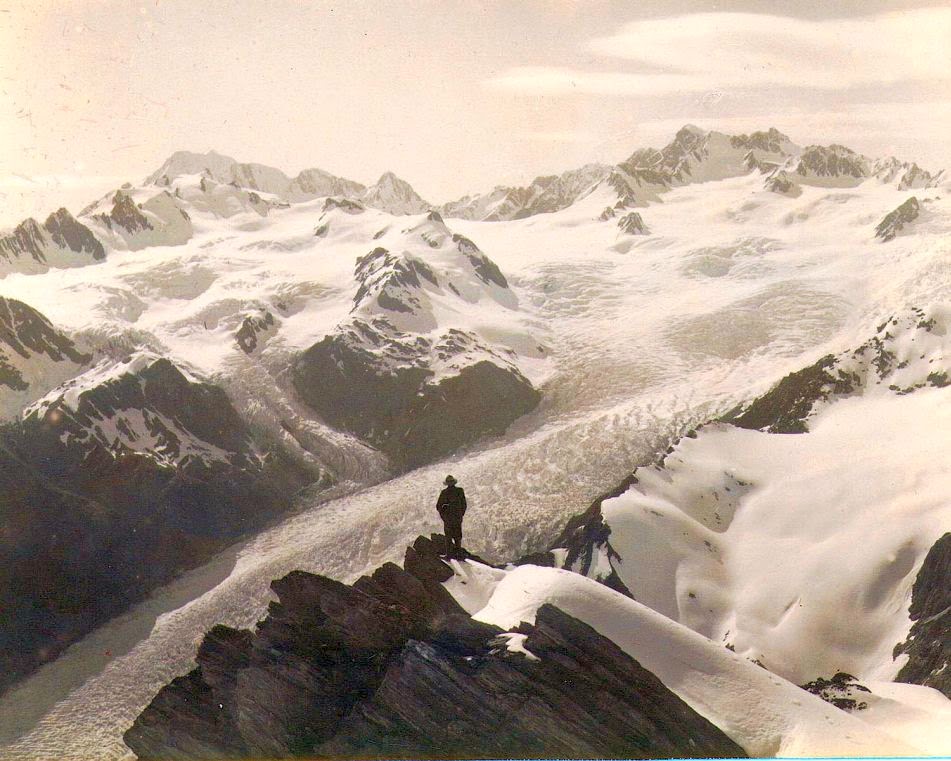
A typical Teichelmann photograph taken from the Fritz Range looking over the Franz Josef Glacier and the main divide with Mt. Elie de Beaumont to the left and The Minerets and de la Beche to the right. What light, composition and texture. Bob McKerrow collection. Christchurch.


Tuesday, August 6, 2013

First Crossing - Ebenezer Teichelmann. TV ONE.


At last, one of Ebenezer Teichelmann's great feats of exploration and mountaineering has been acknowledged on NZ TV. I spent 13 years researching and writing the definitive biography on Ebenezer Teichelmann which was published in 2005. Tonight this was the script on TV One's billboard.
Tuesday 6 Aug
First Crossings 8:30pm - 9:30pm (G) Factual TV ONE
Kevin and Jamie take on the fearsome Cook River Gorge as they retrace the footsteps of pioneer photographer Ebenezer Teichelmann in 1905.

It was an excellent production of one of many of Teichelmann's remarkable journeys during which he did 26 first ascents. What I liked in tonight's production was what I highlighted in my biography on Teichelmann; the love between he and Mary, his role as a pioneer conservationist, his outstanding photography, his coaching of future mountain guides, and the strategic manner in which he promoted tourism. I still have many copies of my book on Teichelmann available and from Paper Plus in Hokitika. Here is the link: http://www.westcoastbooks.co.nz/proddetail.asp?prod=B3877


I also have a blog on this amazing human being: http://ebenezerteichelmann.blogspot.co.nz/


A typical Teichelmann photograph taken from the Fritz Range looking over the Franz Josef Glacier and the main divide with Mt. Elie de Beaumont to the left and The Minerets and de la Beche to the right. What light, composition and texture. Bob Mckerrow collection. Christchurch.


Sunday, June 5, 2011

New information on Ebenezer Teichelmann's father

When I was writing the book on Ebenezer Teichelmann, it was hard to find information about his father Christian Gottlob Teichelmann (1807-1888). Recently I found this very good thesis which throws further light on the Aboriginal area where Teichy spent his younger days.

A Vision Frustrated:

Lutheran Missionaries to the Aborigines of South Australia 1838-1853
by
Christine J Lockwood
A thesis presented in partial fulfilment of the requirements for the Degree of Bachelor of Arts with Honours in the School of Social Sciences,
Flinders University, Adelaide.

2007
CHAPTER 1: INTRODUCTION


On 12 October 1838, Christian Gottlob1 Teichelmann (1807-1888) and Clamor Wilhelm Schürmann (1815-1893), from the Evangelical Lutheran Mission Society in Dresden, arrived in South Australia. Originally hoping to go to India, they began Aboriginal mission work in South Australia at the request of George Fife Angas, Chairman of the South Australia Company. Angas promised five years‟ financial support. August Eduard Heinrich Meyer2 (1813-1862) and Samuel Gottlieb Klose (1802-1889) followed in 1840. By 1853 the mission work of all the four had ceased. In 1848 the Mission Society headquarters moved from Dresden to Leipzig. The Encyclopedia of Modern Christian Missions states briefly: „At first [the Leipzig Mission Society] sent missionaries to Australia but this project did not succeed.‟3 These missionaries do not feature among pictures lining the Leipzig headquarters‟ walls today, or among the biographies on the Society‟s website. The South Australian mission was considered a failure, best forgotten.4

In seeking to understand this apparent failure, this thesis assumes these missionaries cannot be understood apart from their theology, and asks what role theology played in shaping their vision, methods and experience, and in bringing their work to an end.

This analysis of the Dresden men also raises questions of wider significance: Who should be responsible for community welfare and fund it? What is the relationship between church and state, especially when aims and values diverge? The thesis throws another light on the relationship between colonisers and missionaries, culture and theology and warns against a simple identification of Christianity with Western civilisation.

The Dresden Mission Society instructed its missionaries to gather information, keep diaries, and prepare detailed reports. Angas also asked for reports. Consequently these early Lutheran missionaries left significant records and the main source used by this thesis will be the missionaries‟ diaries and correspondence with their Society.

Recent years have seen renewed interest in these Lutheran missionaries for their unique linguistic and ethnographic records of the Kaurna (Adelaide), Ramindjeri (Encounter Bay) and Parnkalla or Barngalla people (Port Lincoln). This arose from resources becoming more accessible to researchers. In 1960 the State Library of South Australia acquired two publications of Schürmann and Teichelmann on the language and customs

1 Teichelmann‟s second name is often given as Gottlieb. Wm Bruce Kennedy, Lutheran missionary to the Aborigines, Pastor Christian Gottlob Teichelmann 1807-1888, His Family, Life and Times, Coolangatta, 1989, suggests his name was misspelt Gottlieb on an official document.

2 Known as Heinrich Meyer.

3 Ernst Jaeschke, in Burton L Goddard (ed.), The Encyclopedia of Modern Christian Missions, Camden, New Jersey, 1967, 267.

4 Dr Lois Zweck, Lutheran Archives researcher. Personal communication.

2

of the Kaurna people, subsequently reprinting them.5 This led to a resurrection of the Kaurna language of the Adelaide area and a renewal of Kaurna cultural awareness.6 Meyer‟s work on the Ramindjeri language and culture7 is being used in Ngarinndjeri language and culture revival programs.8

Other resources becoming more accessible have been Clamor Schürmann‟s diaries and some letters in old-German script which his great-grandson Edwin A Schürmann discovered on microfilm in the State Library of South Australia‟s archives. A partial translation, available in the South Australian Museum, formed the basis for Edwin Schürmann‟s I’d Rather Dig Potatoes, Clamor Schürmann and the Aborigines of South Australia 1838-1853. Geoff Noller is currently retranslating the full diaries for the Lutheran Archives in Adelaide. This material is not all new as diary entries became the basis for letters to Dresden, some of which were printed in the Dresdener Missions-Nachrichten.

In 1984 the Lutheran Archives in Adelaide acquired from the Leipzig Mission Society a large collection of correspondence between the Dresden Society and its South Australian missionaries.9 Leipzig staff had transcribed the old-German handwriting into modern German. The Lutheran Archives in Adelaide now have Schürmann‟s and Teichelmann‟s diaries, and correspondence between Teichelmann, Schürmann, Meyer and Klose and their Mission Society. Some letters are missing. Translation work is unfinished and varies in quality. Different translations exist of some material as accuracy has been hampered by faded, indecipherable handwriting. Friends of the Lutheran Archives, a volunteer group, have published Klose‟s correspondence10 and will soon publish Meyer‟s. Schürmann‟s letters, Teichelmann‟s diary, and letters from Dresden have been translated by Lutheran Archives volunteers. The University of Adelaide‟s Department of Linguistics has been translating Meyer‟s, Klose‟s and Teichelmann‟s letters. Most of Teichelmann‟s letters remain untranslated but, because much of their contents come from his diary, this is not a major omission for the purposes of this paper. This translation work has led to published papers by scholars primarily interested in linguistics, including Mary-Anne Gale, Heidi Kneebone, and

5 C. G. Teichelmann, Aborigines of South Australia: illustrative and explanatory notes of the manners, customs, habits, and superstitions of the natives of South Australia, Adelaide, 1841; C. G. Teichelmann and C. W. Schürmann, Outlines of a grammar, vocabulary, and phraseology, of the aboriginal language of South Australia, spoken by the natives in and for some distance around Adelaide, Adelaide, 1840.

6 See Rob Amery, „The First Lutheran Missionaries in South Australia, their contribution to Kaurna language reclamation and the reconciliation movement,‟ Journal of Friends of the Lutheran Archives no. 10, October 2000; and „Beyond Their Expectations: Teichelmann and Schürmann‟s Efforts to Preserve the Kaurna Language Continue to Bear Fruit‟, in Walter F Veit (ed.), The struggle for souls and science: constructing the fifth continent: German missionaries and scientists in Australia, Alice Springs, 2004.

7 H A E Meyer, Vocabulary of the Aborigines of the Southern and Eastern Portions of the Settled Districts of South Australia, Adelaide, 1843.

8 Mary-Anne Gale, The Linguistic Legacy of H A E Meyer: Missionary to the Ramindjeri people of Encounter Bay, 1840-1848. Conference paper, University of Adelaide, October, 2005.

9 Originals are now in Franckesche Stiftungen zu Halle, Studienzentrum August Hermann Francke archives.

10 Joyce Graetz, (ed.) Missionary to the Kaurna, the Klose Letters, Friends of the Lutheran Archives Occasional Paper no.2, North Adelaide, 2002.

3

Cynthia Rathjen.11 Document locations and translators can be found in the bibliography and will not normally appear in this work‟s footnotes.

This thesis has benefited from the works of church historians A Brauer and F J H Blaess.12 The Dresden Society‟s annual reports and works by Ernst Otto13 and Hermann Karsten14 have provided theological background. In One Blood, 200 Years of Aboriginal Encounter with Christianity: A Story of Hope, John Harris discusses the Dresden missionaries‟ work in the broader Aboriginal Christian mission context.15 In her PhD thesis, Anne Scrimgeour uses Schürmann‟s and Klose‟s letters and Teichelmann‟s diary to explore what she calls South Australia‟s early 'civilising mission‟ and its focus on Aboriginal schools.16 She sees the missionaries as part of the colonisation process and „Christianization‟ as an integral part of the „civilisation‟ of the natives necessary if Aboriginal lands were occupied. This present thesis asks to what extent the missionaries‟ aim was to „civilise‟ the Aborigines.

This thesis is also informed by newspaper articles, Colonial Secretaries‟ correspondence, Protector of Aborigines‟ reports, Angas papers and parliamentary papers which have also been examined by other writers. The records of the missionaries and their Society are the most valuable source because they provide unique insights not widely researched. This is especially so of jointly written missionary letters and conference reports and Dresden letters addressed to its missionaries jointly. Missionary records are often treated cautiously by scholars. They are seen as propagandist or as reporting what mission societies wanted to hear. However these Dresden missionaries‟ records are remarkably frank and honest. They often report things the Society would not have liked to hear and which did not reflect well on the writers. They express despair and failures as well as joys. As suggested by the choice of sources, this thesis attempts analysis from the missionaries‟ perspective.

The photographs of Teichelmann and Schürmann on the monument at Piltawodli (see Illustrations) are of mature, experienced men and these are the images most familiar to us. However, it is important to remember that Schürmann was twenty-three and Teichelmann thirty when they arrived in South Australia. Similarly, Protector

11 Mary-Anne Gale, The Linguistic Legacy of H A E Meyer; Heidi Kneebone, „Why Do You Work? Indigenous perceptions of Lutheran mission work in the Encounter Bay area, 1840-47,‟ Journal of Friends of the Lutheran Archives, no.10, October 2000; Cynthia Rathjen, „A Difficult and Boring Task: Clamor Schürmann and the language achievements among the Parnkalla, Port Lincoln – 1840-1852,‟ Journal of Friends of the Lutheran Archives, no.8, October 1998.

12 A Brauer, Under the Southern Cross, History of the Evangelical Lutheran Church of Australia, Adelaide, 1956; „A Further Page from the Life of the Fathers‟, The Australian Lutheran Almanac, Adelaide, 1930, 41-67; „More Pages from the Life of the Fathers‟, The Australian Lutheran Almanac, Adelaide, 1937, 43-68. F J H Blaess, The Evangelical Lutheran Synod in Australia and the Mission Work amongst the Australian Natives in connection with the Dresden (Leipzig) Lutheran Mission Society and the Hermannsburg Mission Institute 1838-1900, BD Thesis, Concordia Seminary, St Louis, USA, 1940; „Missions – Pioneers in Australia‟, serialized in The Australian Lutheran, Adelaide 1947-1948.

13 Ernst Otto, Hundert Jahre Missionsarbeit, 1979.

14 Hermann Karsten, Die Geschichte der evangelisch-lutheran Mission in Leipzig, Guenstow, 1893.

15 Sutherland, second edition, 1994.

16 Anne Scrimgeour, Colonizers as Civilisers: Aboriginal Schools and the Mission to ‘Civilise’ in South Australia, 1839-1845, PhD (draft copy), Charles Darwin University, 2007.

Link: http://lmw-mission.de/de/files/lockwood-a-vision-frustrated-5136.pdf

Monday, November 1, 2010

Freda du Faur and Ebenezer Teichelmann


On 3 December 1910 a woman stood on top of Aoraki Mount Cook, New Zealand's highest mountain. Freda Du Faur felt “…very little,” and “…very alone,” after climbing to the summit of New Zealand’s highest mountain.

She wrote: 'I was the first unmarried woman to climb in New Zealand, and in consequence I received all the hard knocks until one day when I awoke more or less famous in the mountaineering world, after which I could and did do exactly as seemed to me best.'


That was a hundred years ago today. Let's clebrate this wonderful feat.

During a 15 year period while researching and writing the book I eventually published on Ebenezer Teiuchelmann, who was a climbing contemporary of Freda du Faur, I  interviewed countless people who knew Peter and Alec Graham, and others who has heard second hand from Darby Thomson, who all climbed with Freda de Faur. I also came across many notes, snippets and photos of Freda du Faur, and my respect grew for her courage and ability. Although I have no written evidence of Dr. Teichelmann opinions of her, those who knew Teichelmann and the Graham brothers well,  believed he would have been one of the few male climbers who would have supported her whole-heartedly.

Graham Langton in the 2010 New Zealand Alpine journal acknowledges the influence Dr. Teichelman had on her.  " In late 1906 she and her father visited  the Christchurch Exhibition where mountain photographs by men sucs as Dr. ebenezer Teichelmann inspired Freda to journey to the Hermitage, while her Father returned to Sydney.".

They did meet twice, but more on that later.Here is one of his classic photographs of Aoraki Mount Cook taken in 1905.


Aoraki Mount Cook taken by Ebenezer Teichelmann in 1905 from around Glacier Dome. The East ridge on the left, East Face in the centre and Zurbriggen's ridge at the immediate right of the east face.

Emmeline Freda Du Faur was born 16 September 1882 in Sydney Australia, but lived and grew up 25 kilometres north near the Ku-ring-gai Chase National Park. Much of her youth was spent exploring the diverse terrain of the park, ranging from wetlands to sand stone cliffs, a perfect introduction to the world of rock climbing.

Upon completing her education at Sydney Church of England Grammar School for Girls Freda started training as a nurse. This did not work out and there is some suggestion that she was suffering from bi polar disorder.

Freda spent the next few years traveling and in 1906 made her first visit to New Zealand’s South Island to gaze upon Mount Cook. Photos of the mountains inspired her to go and see it for herself. She stayed at the Hermitage Lodge with its views of snow-covered peaks.

On her second visit to Hermitage in 1908 she met local guide Peter Graham. Under his influence and guidance she progressed from youthful rock climbing to full fledged mountain climbing. By this time she had already decided that she was going to climb all of the major peaks of the Southern Alps of the South Island.

Freda first ascended Mount Sealy within the Southern Alps on 19 December 1909. At the Hermitage, she fell afoul of other women, who insisted she should not spend a night alone with a guide, not even Peter Graham. It is unknown whether Freda was aware of her attraction to other women at this point, and how she privately responded to these concerns about morality. Unfortunately for Du Faur, the designated chaperon proved to be an encumberance. Her well-learnt ropework expertise saved his life when he slipped.

Given the rigour of the alpine environment, Freda dressed practically. She wore a skirt to just below the knee over knickerbockers and long puttees while she climbed. Du Faur wore it on all her subsequent mountaineering expeditions. She contradicted gender expectations after some of her major climbs. Her femininity disconcerted male critics and upset stereotypes about female athletes. She was a practical woman, however, and felt sunburn, dirt and discomfort were minimal discomforts when it came to the excitement of climbing.

Freda Du Faur proved to be a trendsetter in her chosen vocation, not only for similarly motivated women, but for other guided climbers of the Edwardian era. She was celebrated for her rock-climbing expertise, perseverance, and athleticism. Muriel Cadogan trained her for three months at the Dupain Institute of Physical Education in Sydney, before she travelled to New Zealand in November 1910.


The south face of Aoraki Mount Cook. Photo: Ebenezer Teichelmann. Taken 1905.


Mount Cook: December 1910


For 40 years from the mid-1890s alpine climbing was dominated by professional guides. Alec (left) was based at Franz Josef Glacier and Peter (right) became chief guide at the Hermitage in 1906. Guides like the Grahams would take clients on expeditions through the central Southern Alps. The Australian Freda Du Faur (centre) was often guided by the Grahams. Alec and Peter were with her when she became the first woman to climb Aoraki/Mt Cook in 1910. Peter also guided her on the first traverse of Aoraki/Mt Cook’s three peaks in 1913.

Freda's rigorous preparation for the coming onslaught enabled her to climb Mount Cook soon after her arrival in New Zealand. On 3 December 1910, Peter and Alexander (Alec) Graham accompanied her to the summit. Her expedition was the first female ascent of the mountain, as well as the fastest to that date. She shared her tent with the guides. After this expedition, chaperonage, dress, and convention proved to be irrelevant to her enjoyment of mountaineering.

Over four climbing seasons she made many first ascents and notable climbs. Her feats included the second ascent of Mount Tasman, the first ascent of Mount Dampier and the first traverse of Mount Sefton as well as other 3000 m peaks. She made the first Grand Traverse of all three peaks of Mount Cook on 3 January 1913 with Peter Graham and David (Darby) Thomson.

She had great plans to climb other regions around the world including Canada, the Himalayas and the Alps. With Muriel she travelled to England in preparation, but World War 1 intervened. All her plans were set aside and Freda never climbed again.

Freda wrote her book The Conquest of Mount Cook while in London and it was published in 1915. In 1929 Muriel had a breakdown and her family came to take her home leaving Freda alone in England. Unfortunately, Muriel never reached Australia, dying at sea.
Freda returned to Sydney where she spent her time traipsing the nearby bushland. On 11 September 1935 Freda took her own life and was buried in an unmarked grave at Manly. It was not until 2006 that a proper headstone was erected commemorating her achievements.

Lendenfeld (l) Tasman (c) Mt. Cook Aoraki and dampier (l), all peaks climbed by Freda du Faur. Photo: Bob McKerrow

Earlier on in this article I spoke of my knowledge of the Freda du Faur era through my research on Ebenezer who climbed from 1897 to.1924. In her book The conquest of Mount Cook and other climbs : an account of four seasons’ mountaineering on the Southern Alps of New Zealand she refers to Dr. Teichelmann six times on pages., 21, 22, 80, 82, 137, 167 .

On page 81 she describes her first meeting with Teichelmann in 1910 at today's Franz Josef township, then Waiho. "We strolled over to Batson's about 6.30, and there found Dr. Teichelmann, a well-known West Coast climber, and Mr. Linden, of Geelong. They had both been waiting page 81some days for a chance of crossing over Graham's Saddle to the Hermitage. They were starting the following morning under the guidance of Alex Graham for a bivouac up the Franz Josef. We decided to spend at least two days at Waiho Gorge and explore the glacier, and then, weather permitting, follow the others across Graham's Saddle."

On page 82 "The next day, Sunday, was wet, page 82and we amused ourselves as best we could; I sent most of the morning in the swimming hole. Just as we were finishing dinner there came a sound of heavy boots and weary voices in the passage. It was Dr. Teichelmann and Mr. Linden, who had been driven back from their bivouac for the third time that week by bad weather. The doctor was unfortunate enough to have a toe slightly frostbitten, so retired to his room and was not visible that night. Their account of the days spent in the bivouac so diminished our desire to do the Graham's Saddle trip that we decided to return as we had come, endeavouring to piece in the missing bits of the view, and, weather permitting, spend a few hours on the Fox Glacier."

On page 167 "We got some splendid photographs; Alex taking a special one of the great rock slabs of La Perouse for Dr. Teichelmann. I also got a beauty of the ridge between the three peaks of Mount Cook, our situation being the best possible view-point from which to study it. Then deciding that we would have to leave Mount Ruareka for another day, until it had put off its mantle of snow and ice, we made all speed for home. We managed some splendid standing glissades, the tracks of which were seen by Peter and his party, who crossed over the Ball Pass a few hours later. They concluded we had succeeded in gaining our peak."

Like the meeting of the founder of Red Cross, Henri Dunant, and Florence Nigthengale in Paris, we have very little information. As a biographer of Teichelmann,  I would love to know what they talked about when they met at least twice, , what they thought of each other, and did they have anything in common.

Friday, October 29, 2010

Sir Edmund Hillary wrote the foreword to my Teichelmann book

When I finished the book on Ebenezer Teichelmann, I wrote to Ed Hillary asking if he would write a foreword to the book, as I said he and Teichelmann had something special in common, they were both former Presidents of the New Zealand Alpine Clubs. They had both climbed Aoraki/Mount Cook, photo (left) Photo: Bob McKerrow
This is what he wrote:


FOREWORD

As a young climber I came to respect the climbs and exploration done by Dr. Ebenezer Teichelmann, mainly from the West Coast of New Zealand, up those long and difficult valleys such as the Cook River Valley, and his many first ascent were remarkable in that day and age of hobnail boots and long handled ice axes. His third ascent of Mt. Cook in 1905 was a wonderful achievement.I have seen his photographs gracing many NZ Alpine Journals and other books and I am delighted that hardy band of West Coast mountaineers which included not only Dr. Teichelmann, but Peter and Alec Graham and later, my old climbing partner, Harry Ayres, is getting the recognition they deserve.Both Dr. Teichelmann and I are former Presidents of the NZ Alpine Club and I am pleased the club is supporting this important publication on New Zealand Mountaineering, and capturing a bygone era of courage and tenacity in exploration.
Edmund Hillary1 December, 2003.

Monday, July 19, 2010

In Teichelmann country

I have been on the West Coast six days now and doing day trips from Ross. It is strange staying in Ross, as everywhere I go I feel the presence of the Rev. Newton and Dr.Teichelmann. Newton lived here for 6 years and Teichelmann was a frequent visitor. I have done a lot of trips to places which were well known to Teicelmann and I will post a few photos of those places.


On Thursday last week I travelled by the Tranzalpine from Christchurch to Greymouth. Tiechelmann used this rail route a lot. Photo: Bob McKerrow

On Friday morning Kira, Leith and I walked down to Mananui beach, 5 km south of Hokitika and took this photo. It captures the wild mood of the West Coast. There I could pick out peaks I had climbed: Cook Aoraki, Tasman, Elie de Beaumont, Douglas, Haidinger, Haast, Lendenfeld, Dampier, Vancouver, Malispina, McFettrick, St. Mildred, Red Lion and Drummond. For five days I had clear views of the Southern Alps as I moved down the coast. Here are some photos of the journey.

Approaching Arthur's Pass. Photo: Bob McKerrow
The bridge across the Taramakau River.This was the northern limit of Dr. Teichelmann's medical responsibility which stretched from here to Jackson's Bay. Photo: Bob McKerrow

A map of Westland.
Sunrise at Mananui Beach, 5 km south of Hokitika.Photo: Bob McKerrow

With my daughter Kira, and her son Leith at Mananui Beach.
Lake Mahinapua. Dr. T fought against the pro-logging industry to get some protection status for this lake.Photo: Bob McKerrow


Mount Cook Aoraki, Mt. Tasman. Teicehelmann did the 3rd ascent of Mt. Cook Aoraki.Photo: Bob McKerrow


Forest walk to Mananui beach. Photo: Bob McKerrow

Early morning on the Waitaha River. I know this valley well having climbed at the head of County Stream. In 1993 I was in a party that did the first winter ascent and traverse of Red Lion Peaks. Photo: Bob McKerrow


Lake Ianthe, north of Hari Hari. Photo: Bob McKerrow


The Wanganui River with Hendes Ferry on the right. This was where Carl Hende had his residence and was available with horse to assist people to cross. Frequently Teichelman usesd his services and operated on his injured horses. Photo : Bob McKerrow

Teichelmann country. Blue Lookout and the Lord and Lambert Ranges. Photo: Bob McKerrow


The view from the Wanganui river flats looking to the Lord and Lambert ranges. Photo: Bob McKerrow


The Kakapotahi River. Photo: Bob McKerrow


Tasman (l) and Mount Cook Aoraki (r). Photo: Bob McKerrow


The braided Waiho River which drains the Franz Josef, Callery, Spenser and Burton Glaciers. Photo: Bob McKerrow

Franz Josef Glacier. Photo: Bob McKerrow

Franz Josef Glacier from Castle Rocks Hut. Photo: Bob McKerrow

From Almer Hut looking to the Franz neve and the Southern Alps.Photo: Bob McKerrow

Thursday, January 7, 2010

Lake Kaniere, New Zealand.


Lake Kaniere, is one of those moody, spiritual lakes, that beckons you into the high mountains beyond. Photo: Ebenezer Teichelmann

Today I would like to post an extract from my book on Ebenezer Teichelmann, showing the role he played in getting scenic reserve status.

Teichelmann’s participation in the team which pioneered Arthur’s Pass National Park in 1929 must have encouraged him in his desire to protect the special places of Westland. He was concerned that the scenic values of Lake Kaniere were being eroded through the lack of a local management committee to monitor and protect the area.
Sometime in December 1933, Dr Teichelmann approached the Commissioner for Crown Lands in Hokitika to discuss a number of issues concerning the Lake Kaniere Scenic Reserve. On 21 December, 1933, the Commissioner wrote to the Under Secretary for Lands in Wellington.
‘Dr Teichelmann, at the instance of the local branch of the Automible [sic] Association and the Acclimatisation Society, which also acts as a local branch of the Tourist Department, recently interviewed me regarding the prospects of this department undertaking improvements on the Lake Kanieri [sic] Reserve…
‘Incidentally the question of having the control of the reserve formally vested in a local board of control was discussed in which connection it was agreed that this would probably meet with the approval of local people and give an impetus to local interest in the reserve. The Doctor inquired if, in the event of a local Board taking control it would control the revenue from the leasing of boatshed sites granted on the edge of the Lake. I advised him that I would also refer this question to Head Office.’
In his reply 15 days later, the Under-Secretary for Lands advised that there was no prospect of a Government grant or subsidy this year, but that his office would be pleased to see a special Scenic Reserve Board formed to control the reserve, and that revenue from leasing the boat-shed sites could be made available in the future for the Board’s purposes.
Correspondence in the months that follow on the Lands and Survey file show that Dr Teichelmann was the driving force behind empowering local people to take control of the Lake Kaniere Reserve. On many of the letters in the file there are handwritten notes from officials of the Lands and Survey Office, Hokitika, saying ‘discussed with Dr Teichelmann.’ The New Zealand Gazette, number 71, 20 September 1934, announced officially the ‘Vesting of Control of a Scenic Reserve in the Lake Kaniere Scenic Board by Bledisloe, Governor General.’
The following people were nominated for a period of five years: The Mayor of Hokitika, The Chairman of Westland District Council, The Commissioner of Crown Lands for the Westland Land District, The Conservator of Forests for the Westland Forest-Conservation region, Dr Ebenezer Teichelmann, David John Evans and John Noble Robinson.
At the first meeting on 8 October, 1934, a ground committee of Dr Teichelmann, S. C. Darby, Conservator of Forests and J. N. Robinson, was appointed to report in regard to matters for attention at Lake Kaniere.
Dr. Teichelmann had a small batch at Lake Kaniere and spent a lot of time exploring the lake and environs.

The first annual report of the Board shows a far-sighted and hardworking group. They cleared large areas of blackberry, erected notice boards regarding fire control, the destruction of flora, swimming and water pollution; and appointed honorary rangers. They were among the first in New Zealand to express concern about the effects possums, stoats, weasels and rats were having upon native birds. They voiced their concern:
‘The decision of the controlling department to discontinue issuing permits to trap opossums on scenic reserves had caused the Board some concern as it is considered that trappers are responsible for the destruction of much vermin of these reserves such as stoats, weasels and rats. Moreover from enquiries made it is ascertained that the damage done to bush on scenic reserves by trappers is almost negligible, and it is more than favourably offsetted [sic] by the destruction of vermin mentioned which are the natural enemies of our native birds.’
Teichelmann’s involvement in the Lake Kaniere Scenic Reserve Board grew in its first three years, and it became a very effective nature preservation body, but at the same time encouraging recreation. The Doctor's experience from serving on the Arthur’s Pass National Park Board was proving invaluable to steering the Kaniere Board in similar directions. Both reserves today are substantially attributable to the vision of this man. Here was a fine example of one man making a difference.
Doctor Teichelmann was a man with a belief in the preservation of nature for the benefit of all people. But his convictions did not exist solely in the purchase of a few glossy photography books to show visitors, or even the membership of a conservation organization. He lobbied and fought unselfishly for those long term goals. He suffered hardships to explore and record those wonders for those who did not have the means to access the wilderness. He was a man who lived what he preached.

Tuesday, August 11, 2009

Back in Teichelmann country

On the Pioneer Ridge, Fox Glacier, Photo: Dr. E. Teichelmann.

I have been on the West Coast for three days and staying at Ross. Today I travel south to Teichelmann country. Here are a few photos.


Teichelmann's travelling companions in 1905. Another Teichelmann photo.


St. David's Dome (now Mt. Hicks) from the Opus Glacier, near Harper Saddle. Photo by Dr. E. Teichelmann


The Waiho River. Teichelmann spent a lot of time at Waiho. Photo: Bob McKerrow

Friday, July 17, 2009

A letter from Norman Hardie abour Dr. Teichelmann.


Norman Hardie (r) with Tony Streather.


Dear Bob,
Thank you for the kind piece about me in your recent blog.
I was most impressed with your Teichelmann book. My wife's mother was brought up in Hokitika. Her father was MP and an uncle the Mayor. Teichy was family doctor and coached mother-in-law in hockey. On Thursdaqy 9th we will stay at the T B&B for the night, during a nostalgic Westland tour. In 1953 I stayed at Porter's house on two occasions and I met Canon Newton---great men.
Cheers,
Norman Hardie

I was delighted to get this letter the other day from Norman Hardie, the great New Zealand Mountaineer. Here is an article I posted on my blog late last year about Norm.

When I was back in New Zealand in July this year I stumbled across a copy of Norm Hardies book On My Own Two Feet. It is a brilliant book about a simple Kiwi guy who started off working life as a deer culler, which helped him finance his fees at Canterbury University where he obtained an engineering degree. Norm Hardies outlook on the mountains reminds me of Charles Brasch's poem, which describes the uniqueness of the New Zealand mountains...... Man must lie with the gaunt hills like a lover, Earning their intimacy in the calm sigh ... (full version at the beginning of posting)

Norman Hardie knows the South Island mountains like few others. You can feel the intimacy he has for his mountains. It must have come as no surprise in 1956 when Norm was a member of a small party that did the first ascent of the world's 3rd highest mountain, Mt. Kanchenjunga. pictured below from Goecha La (4940m), Sikkim, India.


The ascent of Kanchenjunga is an important part of the book and deserves such a well crafted section, but it is his raw love of the New Zealand Alps that makes the book a classic, and brings together the threads of tramping, hunting, culling, skiing, photography, climbing and his profewssional take on hydro electic generation.


There was an exceptionally good article on Norm Hardie in Saturday's Christchuch Press , which gave me permission to run it on my blog.


His name is not one immediately associated with the world's high peaks, yet Norman Hardie is among the great mountaineers of the great age of mountaineering, writes PHILIP MATTHEWS.
It's like the moon landings. Everyone over a certain age remembers exactly where they were when Apollo 11 touched down but no-one paid much attention to Apollo 12 or Apollo 13.
So it is with mountains. You know who knocked off Mt Everest, but not K2 or Kangchenjunga.
Which is why you probably haven't heard of Christchurch's Norman Hardie. In 1955, Hardie was one of the group that made the first ascent of Kangchenjunga. At 8586m, this is the third-highest mountain in the world, but it doesn't lag behind by much – its Himalayan neighbours Everest and K2 measure only another 260m and 25m respectively.
But it's always about Everest, isn't it? The tallest, the most famous. The most glamorous.
"Everest is nothing like the hardest, though," Hardie says. "Of the 14 mountains over 8000m, it ranks about 10th in difficulty. It's just the fact that it's big and has a pronounceable name, and particularly because the British began trying to climb it back in 1921. They climbed it on the 12th expedition. There had been masses of books about it and a hang of a lot of hype, especially in the English language."
You won't hear it from him, but Hardie is one of the 20th century's great mountaineers. In the foreword to Hardie's 2006 memoir, On My Own Two Feet, Sir Edmund Hillary called him "a skilled mountaineer and a formidable explorer . . . renowned for his considerable determination and refusal to accept defeat".
Michael Ward, medical officer on the 1953 conquest of Everest, called him "an outstanding mountaineer and surveyor, whose feats can be compared with those of Oliver Wheeler and Henry Morshead on Everest in 1921 and of Michael Spender in 1935".
Even if those names mean nothing, you know that's heady praise. Surely there should be statues and plaques, perhaps streets named after him. But the lack of attention back home isn't a concern. "They make a fuss of me in Germany and Japan. And the British do, too. I've never been worried about it."
Hardie is 83 now, officially a semi- retired engineer and living a quiet life in the hills of Cashmere. Where else would you find him in an otherwise flat city? Even the driveway is a perilous ascent. There is a sheer wall of mountaineering books and journals in his study, and a cluster of Nepalese artefacts. There is a view of the distant Southern Alps. There are photos from the last reunion of the Kangchenjunga party – of the original nine, only four remain.
Among serious mountaineers, Kangchenjunga was seen as an enormous challenge and a glittering prize – definitely a tougher climb than Everest, Hardie reminds us. Earlier German expeditions had come within 1000m of the summit but were driven back by bad weather. But with oxygen tanks designed by Hardie, Joe Brown and George Band reached the top on May 25, 1955. Hardie and Tony Streather followed a day later. And it would be another 22 years before anyone else would match them.
Their feat was even more astonishing when you consider that the 1955 expedition was only supposed to be a reconnaissance mission for the real effort the following year.
It was another time, the closing of the great age of exploration. By the end of the 1950s, the world's major peaks had been conquered and much has changed since. Everest has become "a playground", some say, just another stop on the adventure- tourism circuit.
Any would-be climber can buy the services of an experienced guide and pay their way up – New Zealander Rob Hall, a man Hardie knew well, died on the mountain in 1996 while looking after a client who had collapsed near the peak.
Yes, the commercialisation of climbing is a concern. "It worries me because a lot of people have been to the top of Everest and never seen snow before in their lives. People from Hong Kong and Singapore. A woman from the Philippines got to the top of Everest last year. It cheapens the whole thing."
Hardie served his climbing apprenticeship in the Southern Alps and first encountered Hillary there in 1948. It was the year of the famous Mt La Perouse rescue, when the injured Ruth Adams was carried down from the mountain in a stretcher. This has been called "the most arduous rescue in New Zealand's climbing history".
That story is a reminder of just how tough our backyard can be. For years, Hardie was called on to help look for lost climbers in the South Island. He can still vividly remember the time he was caught in an avalanche on Mt Rolleston during such a mission. "Unconscious for a while there," he says quietly. "Thought I'd had it. Slowly going out as the oxygen runs out."
The same avalanche took the life of his good friend John Harrison. The bodies of the four lost climbers they had looked for weren't found until months later. And that, he writes in his understated way, was to be his last high mountain search.
As for putting it all down in a memoir, he says that he "got pressured from all sorts of people saying that my story ought to come out. The official book on Kangchenjunga – by Charles Evans – was the most restrained, controlled book I've ever struck. A very gentlemanly British thing that didn't give anything like the whole story."
After Kangchenjunga he kept up a relationship with that part of the world. He made 14 trips to Nepal and only the first three were about mountain climbing. He spent 22 years as a director of Hillary's Himalayan Trust, helping to build schools and set up the Sagarmatha/Everest National Park. In 1960, he joined a team that had the very serious purpose of high- altitude acclimatisation research and another, more frivolous mission – to track the yeti.
How seriously was this taken? "The American members of the party took it very seriously. There were 22 of us from four different countries. The American sponsors were concerned that the medical research wouldn't get any publicity so they talked Hillary into going along with looking for the yeti. All of us who had been there before were very cynical about this. But it paid for the expedition and everyone had a good time."
And it might be a ridiculous question but was there any evidence? "There were footprints in the snow but they were just badly identified orthodox animals."
He went south, too, making three trips to Antarctica over 20 years. Once to instruct Americans in the right way and wrong way to tackle snow and ice, once to join Hillary's party for the first ascent of Mt Herschel and once as leader of Scott Base.
It was much harder then than now to make a living out of mountaineering. In the afterglow of the ascent of Kangchenjunga, that was something he had to consider. "Was I going to go a Hillary way and stay in this sort of thing permanently and somehow make money out of it? But I was already qualified as an engineer and decided to stick to that.
"Once I started to establish myself, I got all these invitations to free expeditions. I never ever went on one that got paid. I had to be grateful for having a co-operative wife and a co- operative business partner – I was able to go away for so long and so many times. It's no good going to the Himalayas for a fortnight. You're pretty useless for the first two weeks."
So bursts of adventure were slotted into domestic life. He had married Enid Hurst in 1951 and they had two daughters. He became a consulting engineer for a firm in Christchurch in 1956 and then a partner in his own firms. And until recently he was to be found kayaking and tramping around the South Island.
Can a sense of adventure be genetic? You might ask this if you heard about his older brother, Jack. A quick search of Nelson newspapers shows that one Jack Hardie holds a record as the oldest man to have ever skydived at Motueka airport. It's become a tradition: every January, Jack marks his birthday with a plunge, as it coincides with the day that he was shot down over Holland during World War II. "The parachute saved him and as a result of that, he does this thing every birthday."
In January, Norman and Enid will be in Nelson to watch Jack plummet out of the sky again, at age 90.
Planes, mountains – Hardie has had something else on his mind lately, too. It's that great South Island subject: water.
In 1948, as a young Ministry of Works engineer at Lake Pukaki, he had a brainwave. If the west coast of the South Island is wet, and the east coast is dry, why not pipe water from one side to the other? The idea hibernated for decades, but by the early 1990s, the surveying maps were accurate enough to see that the Landsborough and Douglas rivers on the western side are higher than Pukaki on the eastern side, meaning you could do it without pumping water uphill.
Among his collection of geological maps, rain graphs and engineering drawings, he has some photos of the Landsborough Valley: the glaciers, the moraines, the boulders. "I began with the Landsborough because I knew it so well through mountaineering.. All the mountaineers and shooters who go in there know it's really wet and the river comes up pretty fast and stays up for a long time."
It's entirely feasible, he believes, to put 25 kilometres of tunnels through the Alps and pipe the river water into Lake Pukaki. And as everyone who has spent a winter in Canterbury knows, the level of Pukaki and other hydro lakes are a matter of day-to-day anxiety. This could be a way to keep the levels up, without damming rivers and flooding valleys. As one Press correspondent wrote after reading about Hardie's scheme, "The forests and snails of the Copland Valley would be unharmed".
It sounds ingenious. The Press understands that this idea was put to the old Electricity Corporation of New Zealand (ECNZ) in the 1990s and that there was some interest before the carve-up of ECNZ into Meridian, Mighty River and Genesis. So has it been on Meridian's mind again since? Spokesperson Claire Shaw says that while "it's a very interesting concept that we're aware of" and "there are clear benefits to the project for hydro storage in New Zealand", it comes with significant challenges as well. Quite a few of them, she says.
"We have no plans to pursue it in the near future," she adds. "We have a whole host of options that would come before that."
Too bad. In the meantime, Hardie's legacy can rest on his mountaineering exploits. It's strange to think of it, but in all these years he's never reflected on what makes a great mountaineer. Can he define it? He pauses and considers this for a while.
"Fitness is obvious but you also need some appreciation of the high country, whether it's geology or weather," he says. "And certainly the ability to get on with people you're with if you're stuck in a small tent for three or four days."
And presumably you need patience? "Yes. Yes. I believe too that you should never stick your neck out too much. Don't take too many risks. If the weather's not on or you're not feeling well or your climbing companion has bust his equipment, give it away. The mountain will still be there tomorrow."

Thursday, July 2, 2009

To the Cook River and Mount La Perouse - 1906. Ebenezer Teichelmann

David's Dome (now Mt. Hicks) and Mt. Cook Aoraki from the Opul Glacier below Harpers saddle. Photograph: Ebenezer Teichelmann.

One of the great expeditions that Dr, Ebenezer Teichelmann led was in 1906 when he went up the Cook River Valley and over Harpers Saddle to the Hooker Valley and Mount Cook. En route they did the first ascent of Mount La Perouse. Here is the chapter from my book describing this magnificent journey.


1906 Cook River and Mount La Perouse

Flushed with the success of their 1905 expedition, the West Coast trio decided on the Cook River again, and the unclimbed Mount La Perouse as their main objective. They were joined this time by their companion from the Mount Cook climb: the Scottish climber, Mr R. S. Low. Greatly liked by the Doctor and the Reverend for his good natured humour and quiet, unassuming manner, Low was regarded as a skilled climber on both rock and snow. Another prospector, Charles Anderson, helped Alec Graham set up a base camp, a little higher than last year's one. Anderson had been working a gold claim in the Cook River, opposite the Digger’s Huts. He was a true bushman, sleeping in one blanket and a cocoon of ferns. Alec Graham was amused at the sight of smoke seeping out of a pile of ferns as he settled down for the night with his final pipe, rather like a talking haangi (a Maori cooking pit).


Ebenezer Teichelmann in the Cook Valley, 1906
When Newton arrived at Waiho on 17 January, he was pleasantly surprised to be reunited with an ice axe he had lost four years earlier on his first trip to the glacier. It had been discovered just a few days previous to his arrival, with its shaft sticking out of the ice of the glacier terminus. Apart from rust on the pick, it was in good order. Teichelmann, Low and Newton joined up with Alec Graham about a week later, and they swagged up the Cook River to La Perouse Glacier. A high camp was made on the spur which separates Gulch Creek and La Perouse Glacier. They had good views of the head of the valley, plenty of firewood, and a stream nearby. They even had sugar and biscuits from the year before.
It dawned fine on 1 February, 1906, but with fog in the valley below. The party of four left the high camp just before 4:00am and soon crested the main ridge. They had to traverse around two steep dips on the ridge before reaching the col and ridge leading up to the summit of La Perouse. It took a whole hour to negotiate the first gendarme. They had attacked it head on, only to discover that there was no way down off the other side. So back they went. Newton was last to descend, and his camera once again caused him grief. Determined to avoid the problems of 1905, he tied it to his rope and lowered it off. It kept snagging on rock projections, and it suffered damage with the crashing about. Later he was dismayed to find the shutter damaged. A rest day with the equivalent of a Swiss army knife and he had manufactured new parts sufficient for its continued use during that expedition.
The climb was straightforward, although a fair number of steps were required. They were pleased to find that the arête that had looked so sharp and steep from the Cook River flats was not too bad in reality. It was in excellent condition with a good firm coating of snow. It was a thrill for Alec Graham, who recalled his feelings of that moment. ‘It was my first real mountain, and a 10,000 foot virgin peak.’
It was only 10.50am when they stepped the final rise. There was plenty of time to linger on the top and take in the stunning view, especially of neighbouring Mount Cook, and to relive the excitement of the previous year. Newton carefully studied an unclimbed route on Mount Cook, known today as Earle's route. He expressed his desire to return one day to climb it. And as they sat on the summit, one wonders if they thought themselves a weird bunch. A Scot, an Englishman, a German/Scot born in Australia, and a New Zealander sitting on a peak named after a French navigator. Teichelmann, Newton and Alec Graham had forged not only friendships, but had become a formidable climbing combination that was on the brink of greatness.
They descended by a different route, using a snow slope on the La Perouse Glacier side. This was the route later used in 1948 by the famous Ruth Adams rescue party, which included Sir Edmund Hillary. Using judicious glissading, they returned to camp in just one hour 27 minutes, compared with over six hours for the ascent.
A few days of bad weather followed and the group explored the La Perouse Glacier. From it they climbed up to a col on the Balfour Range, which lies opposite Katies Col on the Fox Range. They had a good view of the upper Balfour Glacier and its spectacular display of avalanches from the hanging section down onto the lower glacier. Clarke Saddle was identified further east: another objective. To the south they traced their route over Harper Saddle. Just to the east of that sat the imposing bulk of Mount Hicks, then known by the more lyrical name of St David’s Dome. As it was also an objective, they carefully scoped out routes from the north, and even a potential bivvy site. That done, they got up and traversed east to climb a small rock peak. It is unclear whether this was Vanguard or a closer rock pinnacle.


Dr Teichelmann’s much traveled full plate camera was carried to this spot. Alec Graham, who spent much of his early guiding years carrying the Doctor’s camera best describes his passion.
‘The Doctor was very thorough in everything he undertook and it took a long time, sometimes, to get just the right composition he wanted. He never failed to ask me to look through the viewfinder to see if I could suggest any improvement, for he always liked me to help him. When on any sharp peak I put the rope on him as he was so interested in getting what he wanted that he was liable to forget where he was standing when he had his head under the focusing cloth. Then, when he was satisfied with the composition of the picture he was taking, there was the right aperture and time for the exposure to be carefully adjusted and checked.
Mr Newton would sometimes get a little impatient with the Doctor for taking so long. The Doctor would reply, “I'm not going to let Alec carry the camera all the way up here and then make a mess of it. The difference between you and me, Newton, is that is that you are a photographic climber and I am a climbing photographer!” ’
Next morning they set off for Clarke Saddle, but heavy snow and deteriorating weather at the second icefall repulsed them. The next day the elements kept them at bay, enforcing time for repairs and ablutions, philosophizing and observing.
The four explorers had waged some competition with the wekas and keas over ownership of certain items. For some unknown reason, their soap was in particular demand from the wekas (New Zealand native bird). When the Doctor decided to wash a shirt the following wet day, there was only one small piece remaining. The other three sat and watched as one particular weka stalked through the scrub towards where the Doctor sat washing by the stream. Bemused, they kept silent. Every time he put the soap down on a rock, the weka would line up an attack, to be foiled at the last minute by the unsuspecting Doctor picking it up again. Finally, the weka struck in a lightning raid, and raced off into the scrub with the enraged Doctor in pursuit. The soap was lost, but the audience deemed the entertainment well worth the price.
When the weather cleared at their base camp on the La Perouse Glacier, they readied themselves for the next objective: St. David's Dome, now called Mount Hicks. Unfortunately the Doctor had bruised his heel and elected not to join. It was late in the afternoon when Newton, Low and Alec Graham left for a higher bivouac below the first ice fall on the La Perouse Glacier. That night as they ate their meal, Newton remarked how he missed the Doctor's company, but said it was rather nice having a meal without the Doctor’s eye on you. Graham and Newton had wolf-like appetites, while the Doctor, a small eater, would jokingly remark that it was no wonder they had to carry such heavy swags.
On 9 February the party got away at 2:30am on a very warm morning. Following their previous route through the first icefall, they turned right on to a long snow ridge running down from Mount. Hicks (referred to in Anderson's Jubilee History of South Canterbury as the north-west arête), joined the main west ridge higher up. They struck soft snow on the lower part of the ridge, but step cutting became necessary higher up where conditions were colder. At the top of the north-west ridge, they struck a rock face which provided excellent climbing onto the main west ridge. The final section of ridge to the summit was climbed in gusty conditions. The force of the wind necessitated a straddle shuffle along one section of the icy ridge. They reached the top at 11:00am. It was so windy there that Newton had to lie down to take his photographs. Sheltering from the wind on the eastern lee of the summit, they had time to admire the neighbouring flanks of Cook and Dampier.
The descent was by the same route. It had been a long time since they had last quenched their thirst, so a stop was made on the rocks just before the glacier. The billy packed ready with snow, Newton got out the bottle of meths. In a second, it had slipped from his hand and shattered on the rocks. The meths quickly evaporated. Without a word, but with parched mouths worsened by anticipation, they packed up and continued on.

Meanwhile, back at base camp, Dr Teichelmann was having an enjoyable day with his camera. His heel injury was rapidly improving. He was obviously pleased with the first ascent of Mount Hicks by his team mates and congratulated them warmly and enthusiastically on their return. They were more interested in the contents of the boiling billy than his congratulatory speech.
Mr Newton and Dr Teichelmann were running out of holiday time, so they returned to their respective employments in Ross and Hokitika. Their companion Mr Low, whom they had come to respect and like, travelled back with them as far as Waiho. Alec Graham and Charlie Stoner transported out the remainder of their gear.
When Alec Graham returned to his home in Waiho, Mr Low was there and somewhat anxious to return to The Hermitage via Graham Saddle. He asked Graham to accompany him part of the way. The next day they camped under a rock on the Baird Range, below Goat Path.
‘We started early next morning and I went with him well out over the Franz Josef snowfields. Here we parted and I returned to the base of Mildred Peak and watched him cross the saddle. I did not feel anxious about him going alone, for he was a very careful and safe climber and should have reached Ball Hut before I got back home.’
It was 10:00am, Wednesday 21 February, when Alex Graham headed home to Waiho from near the Mackay Rocks. An hour later Mr Low was ready to descend into the Rudolf Glacier, having safely crossed Graham Saddle. He stopped for a short rest at the top of a couloir that led down onto the glacier. Conditions were good, and progress swift, so he resolved to travel right through to the Hermitage that day, rather than spend a night at Ball Hut. He bent and picked up his swag. It was bulky, but not heavy. He had only brought provisions for one day in order to travel light and fast. Shouldering his swag, and picking up his ice axe, he stepped carefully down into the couloir.
Not bothering to cut steps, he slipped into the repetitive rhythm of placing the axe firmly, then stepping down. Thoughts elsewhere, he was caught unawares
when his feet slipped on a small patch of ice. Quickly he rolled into a self-arrest position to brake his accelerating fall. Panicking, he drove the axe in hard. His momentum was too great, and the axe was wrenched from his hands. By now he had gathered considerable speed, and a hungry schrund below opened wide in expectation. It was not to be. Slamming into some protruding rocks, he heard and felt his ankle crunch and twist. The pain was excruciating, and he knew it was unusable. If not broken, it was at least badly dislocated.
Low dragged himself to safety behind some big rocks and collapsed. Wisely, he rested there. His racing thoughts gradually slowed, and he formulated a plan. He was a long way from anyone, and would not be missed for some time. He may be crippled, but one look at the gaping schrund below at the base of the couloir, and he realized that those rocks had undoubtedly saved his life. He had lost his ice axe and all his food, except for a tin of milk and some chocolate. At least he had plenty of tobacco, he thought, lighting his pipe. The options were grim. To descend meant a crawl with no ice axe down a hard frozen slope. Waiting for the sun, he needed the softened surface to gain some friction on the slope. Carefully, with two hands and one boot, he inched down to a snowbridge over the crevasse. An icy breath from the depths of the blue/black maw sent a shiver down his spine as he crawled across to the safety of the glacier. Now seated, he propelled himself out onto the centre of the glacier. There he spent the night, thankful for the insulation of his sleeping bag.
It took three painful days in snow and cold to crawl down the glacier, dragging himself along the last day in two feet of fresh hail and snow. Waiting for the assistance and comfort of the sun, he leashed his pack to one end of his rope, and himself to the other. Dragging himself a rope length, he would then wind in his pack. In this manner he passed his second day. That night was spent sheltered behind a large rock on the ice. His fierce thirst could be slaked with small pools of meltwater, or dribbles on rocks. Once he had gained the moraine, he had to crawl with his pack on. Its bulk exaggerated his movements, and balance was awkward. It snowed heavily that night. The de la Bêche rock bivouac was only three kilometres away, but it took all day, crawling over rough moraine and through sixty centimetres of snow to get there.
For another six days Low waited, living on a hundred grams of cocoa found in the bivvy, half a loaf of bread he had recently found in the bottom of his swag, and water collected from drips on the rock. As the days passed and his meagre supplies diminished, so did his hopes of ever being rescued. He wrote his last requests on the mica sheets of a headlamp, and with his own blood he wrote his thanks to his climbing friends on a map that Alec Graham had lent him.
Four days after Alec Graham had seen Mr Low go over Graham Saddle, he and Dr Teichelmann were worried by the non-arrival of telegrams which Low promised he would send when he arrived safely at the Hermitage. Both Alec and the Doctor wired the telephonist at Tekapo, who sent a message by pigeon to the Hermitage. Foolishly, the telegrapher tied the whole telegram to the pigeon's leg who, after having pecked it off, flew to The Hermitage without it.


Nine days after his accident, two friends of Low arrived in Waiho, having crossed the Copland from the Hermitage. One was Professor Marshall, and the other Doctor Bell. Low was engaged to be married to Dr Bell’s sister. They had been waiting at the Hermitage for Low to join them, so when they heard that he had left nine days before, they were justifiably concerned. The nearest telephone was 15 kilometres north at the Forks, but eventually a message was passed to Lake Pukaki, the closest telephone to the Hermitage. Realizing the importance of the eaten telegram, someone rode at speed through to the Hermitage. Jack Clarke and Peter Graham set off at once, even though it was 8:00pm. Fearing the worst, they traveled through the night, knowing that it would be at least de la Bêche corner before they would find any sign of him. At 4:00am they were relieved to hear Low’s answers to their calls as they climbed up from the Tasman Glacier.
‘Though terribly thin, Mr Low was able to sit up and tell us what happened. His first request was for tobacco, which Jack was able to supply. He was very hungry so I made some soup and gave him small but frequent helpings while Jack examined his injuries. There were abrasions on his face and hands and a fractured ankle, but he was suffering most pain from his knees. They were severely lacerated after crawling two miles over broken moraine.’

The best Peter Graham could do in the way of a mountain radio was to carry on his back the carrier pigeon, Dick Seddon, named after another famous West Coaster. Battered and ruffled, he was entrusted with requesting a doctor and others to come and help. Twenty minutes after repairs in the sun on a rock, Dick was back at the Hermitage. Later that day, with great relief, Dr Teichelmann received word in Hokitika that his friend was alive.
Peter and Jack then raced over Graham Saddle to the Waterhole below Goatpath, where they met Newton and reported the good news of the discovery. Later the following day they were back with Low, to assist the nine men who had arrived to transport Low. The doctor who had joined them was Dr Truby King of Plunket fame.
It took ten hours to carry Low to Ball Hut. There they strapped him to a mattress on Hanmer Jack, an old grey horse, renown for his sure footing. He was met by a coach that took him through to Timaru for x-rays. Transferred to Christchurch, Low then suffered further complications which nearly cost him his life. Eventually he recovered, and went on to do some more climbing, but it was never the same again due to the chronic ankle injury.
Low's dramatic rescue brought mountaineering to the front pages of all New Zealand newspapers. Up to this time, it was Malcolm Ross who brought mountaineering to the attention of the public using a style that John Pascoe regarded derisively: ‘He was too wedded to his easy-come-easy-go journalism and his uncritical gusto got the better of him.’ But regardless of style, Ross popularised mountaineering. Teichelmann also contributed greatly to popular literature of New Zealand mountaineering before the First World War with entertaining articles superbly illustrated with photographs in various magazine and newspaper supplements.
Not long after Mr. Low's miraculous rescue, the Doctor received word from Australia that his mother, Margaret Teichelmann, had died on 30 March 1906 at the age of 82.